
Worm composting has become more and more popular as a way of beefing up your garden soil –
especially if you have a sandy soil like that in Westville.
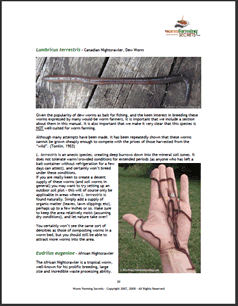
As the demand for worms has grown so to has the cottage industry of farming worms for sale. The image you see here is from the Top Worm Farming Manual to show you how to run a profitable worm farm business.
If you want to know more simply click on the image.
A UK reader asked this question and the answer was supplied by an experienced worm farmer
“Hi, I have read that worm farming can be profitable and I would like assistance on how to set-up a worm farm. Any help would be great.” ~ Gareth K.
Hi Gareth,
Like most businesses, a worm farming business is one that requires a lot of time and effort in order to become really successful – there is simply no way around this. Hopefully you weren’t informed that worm farming is an ‘easy’ way to make a profit. The harsh reality is that most people who start up their own worm farming business will have a really tough time making a go of it, and many will completely give up.
With that dreary news out of the way (haha), let me assure you that worm farming CAN indeed be profitable, and also an interesting/rewarding way to earn a living.
There are two schools of thought when it comes to the best approach for starting a worm farming business. Some industry experts insist that the only way to find real success is to research the market thoroughly then jump in with a large outlay of capital for equipment and initial worm stock. Others (myself included) feel that a slower, safer approach is MUCH more practical way to get into the business.
The only way I would recommend the first approach is if you REALLY know what you are doing – both in terms of raising worms, and (even more importantly) in terms of running a business as
well. I would also strongly recommend that you only go this route if you are already in a secure financial position, and can handle the loss if the business doesn’t work out. In other words, don’t
go ‘maxing out’ your credit cards just so you can start out on a large-scale. That is just an invitation for trouble.
One of the major stumbling blocks for people starting up a worm business is focusing way too much on breeding worms and making castings, and not nearly enough on finding a market for their products! Unfortunately, it’s not like in the movie ‘Field of Dreams’ where ‘if you build it, they will come’! 🙂 The sad truth is that if ‘they’ don’t know you exist you’ll just end up with a surplus of ‘product’ and nobody to sell it to!
Taking the route that I recommend, you can be a lot more relaxed about it. You simply start small – even a single small worm bin will get you started – and go from there. This allows you to ‘learn the ropes’ as you go, but it also buys you a lot more time in general. You can use this time to learn more about potential markets and ways to connect with future customers.
Once you master the art of caring for a worm bin, your worm population will happily grow, allowing you to expand your stock out into multiple bins or beds if you chose to do so. Space will
of course be a consideration. In a perfect world, you’ll own a farm or rural property and will have the space to spread out in. That said, I have heard of city dwellers who started their worm
businesses in their basements and backyards – so it CAN be done.
This extra time will also allow you to determine if worm farming is the right business for you. It is much better to discover you don’t really enjoy it after spending $50, rather than $200,000,
right?
I would say with some confidence that the vast majority of people who are making decent money in the worm business are truly passionate about what they are doing! It’s not about getting
rich, and in fact while some do make a comfortable living, the number of (ethical and honest) worm farmers who are ‘rich’ is very small.
I see worm farming as having a lot of potential as a really enjoyable side business – perhaps something you can build up into a full-time endeavor, but again there is no pressure to do so.
Anyway, Gareth – hopefully this answers your question at least somewhat. This is a topic that deserves much information than I can provide here, so hopefully we’ll get to revisit it again
before too long.
Just so you know, our worm farming manual covers the topic in much greater detail, and there are plenty of full-time worm farmers who are happy to share their expertise on the member
forum as well.
Regards,
Bentley Christie